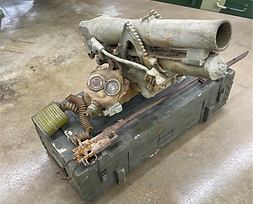

WWII Japanese
Artillery* Collection
The Museum's
WWII Japanese artillery is relatively rare.
There were never large quantities manufactured, and some were outdated designs and calibers exclusive to Japanese forces. Note the prevalence of wooden, steel-rimmed wheels on most. Nevertheless, the artillery was generally adequate until the United States was drawn into the war.
After the war, little use was made by other countries of captured Japanese artillery. With the exception of China and Southeast Asia, the artillery was mostly located on islands, which made it difficult to recover.
Of note, however, we have a US Field Manual from the early 1960's Vietnam era which shows some Japanese artillery that could be encountered in use by the Viet Cong.
The Japanese artillery in the museum was brought to the United States on empty merchant marine ships after WWII. Located mostly in California, we know of two that were used on movie sets prior to being acquired by the museum.
The majority of the Japanese artillery on display was significantly deteriorated from being on tropical islands. They all required an extensive professional restoration which took over two years to complete and is a story in itself.
Type 38 75mm Field Gun


De-milled


Our Type 38 (Model 1905) is a German Krupp design, license built at the Osaka Arsenal in Japan. Originally made with an interrupted thread breach, this one was modernized with, among other improvements, a horizontal sliding breach block. As with our other Japanese artillery, our cannon was recovered from one of the pacific islands.
These cannons were also used in Southeast Asia during WWII. During the early 1960's Vietnam war, they could still be found in use by the Viet Cong until replaced by more modern Soviet artillery.
Type 41 75mm Mountain Gun
De-milled


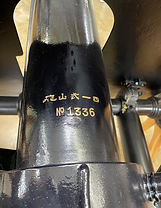
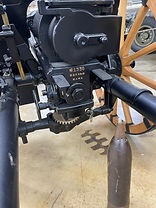
The Type 41 was license built Krupp design adopted in 1908, hence the Meiji year designation Type 41.
The cannon was intended to be broken down and hand carried by its' 13 man crew if horses were not available.
During restoration, it was discovered this was a marine cannon evident by traces of the original blue/black paint and the marine anchor.
Additionally characters were present on the right which roughly translates to "the world under one roof" meaning Japan.
Type 91 105mm Howitzer SN #42 of the 77 Made by Schneider for Japan
De-milled


The Schneider built Type 91 is a rare cannon.
Japan was modernizing its army in by the 1930s to a larger 105mm caliber in line with the USA, Germany and others.
Departing from its' contemporaries, the type 91 was designed lighter as Japan's artillery was primarily still horse drawn. Nevertheless, the ballistic performance was somewhat comparable.
Type 92 105mm Howitzer Extensive Battle Damaged - Japanese Produced
De-milled


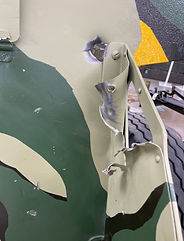


Based on the Schneider design, approximately 400 were made at the Osaka Arsenal in Japan. This cannon incurred significant ballistic damage from shrapnel, bullets, and one 20mm cannon penetration. All were incoming from the front. It appears the cannon was in transport mode.
During restoration, it was discovered that the second layer of paint was a camouflaged pattern replicated as you see.
Type 1 47mm Anti-Tank Modern Gun Based on the German Pak 36
De-milled


The Type 1 bears a strong resemblance to the United States 37mm M3 and especially the Soviet 45mm M1937 anti-tank guns, both of which can trace their origins to the 37mm German Pak36. Approximately 2,300 were manufactured during the war.
Like the 37mm and 45mm anti-tank guns, the Type 1 also became ineffective against tanks but still filled a role as an infantry support gun.
Type 94 37mm Anti-Tank
De-milled


During the early 1930s, Japan like Germany and the United States, developed a quick firing 37mm anti-tank cannon. At the time, 37mm was considered "large" compared to the contemporary cannons such as the French 25mm anti-tank guns.
Like most Japanese cannons, it was built lighter weight than the German and US cannons of the era.
The Type 94 was entirely a Japanese design.
The various mechanisms are significantly different compared to other countries and the cannon was probobly simpler to manufacture.
Type 4 150mm Howitzer
De-milled


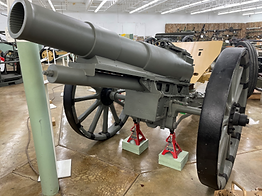

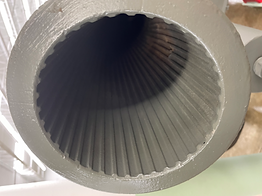

Designed and built at the Osaka Arsenal, the type 4 was based on an earlier Krupp design. While not the best cannon of the era, relatively large quantities were made and it was in production until late in the war. Note the museum's example, SN 354, is early production.
Somewhat unique is the cannon being lightweight for the caliber.
Due to the lighter frame, the barrel which is heavy for the caliber, was usually removed and transported separately. Note the slender trail and solid axle with wood wheels.
Despite the apparent shortcomings, the Type 4 did work well considering the high angle of fire, light weight and portability in the terrain where it was used.
Type 98 20mm Anti-Aircraft Mitsubishi Built
De-milled




Type 88 75mm Anti-Aircraft
De-milled


Type 92 70mm Battalion Gun Relic
Recovered on Saipan